"These may lead to feelings of being manipulated, feeling lack of control related to certain behaviors, and feelings of dependence on checking or going on Facebook that could be related to lower well-being - and could be fueling the subjective, colloquial experiences of feeling 'addicted' to Facebook."
"We hypothesize that unpredictable, low value rewards and cues that promote frequent, automatic, undesired behaviors are contributing to reward learning and habit formation in a way that is not aligned with users' intentions or preferences."
"These may lead to feelings of being manipulated, feeling lack of control related to certain behaviors, and feelings of dependence on checking or going on Facebook that could be related to lower well-being - and could be fueling the subjective, colloquial experiences of feeling 'addicted' to Facebook."
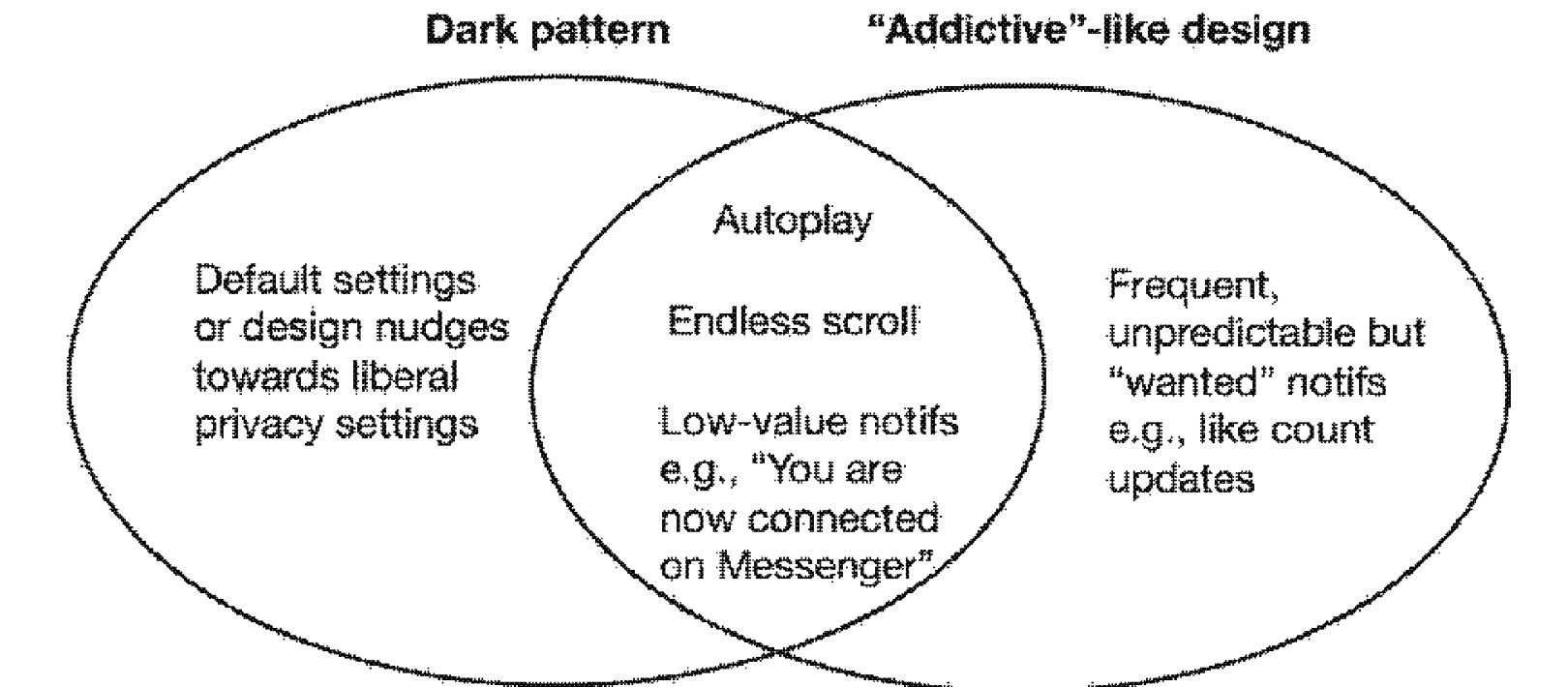
"Partner with design to refine a definition of what aspects of features promote 'addictive'-like/problematic behaviors to target in the audit and how they're different from/related to dark patterns. Specifically, features are problematic if they promote:
• Unpredictable, low-value rewards (e.g., certain notifications)
• Low-control or automatic behaviors (e.g., autoplay)
• Frequent behaviors that are pressured or unwanted (e.g., read receipts)
• Define other criteria"
"Q: How is an 'addictive'-like design element similar vs. different from a 'dark pattern'?
A: 'Dark pattern' is a UX term referring to interactions that are deceptive, or that trick you into doing something you didn't want to do.
These include misleading or manipulative features or settings that are designed to encourage a particular behavior that is not necessarily in the user's best interests. These can include single-instance behaviors."
"'Addictive'-like design elements are those that promote repeated or poorly regulated behaviors that may have a negative impact on the individual over time as they continue behaviors that aren't in their best interests."
"A dark pattern deviates from user expectations; an 'addictive'-like design results in a behavior pattern that is not wanted or valuable for the user over time (the function of the design is to promote repeated maladaptive or low-control behaviors)."
 Meta & Children's Online Safety