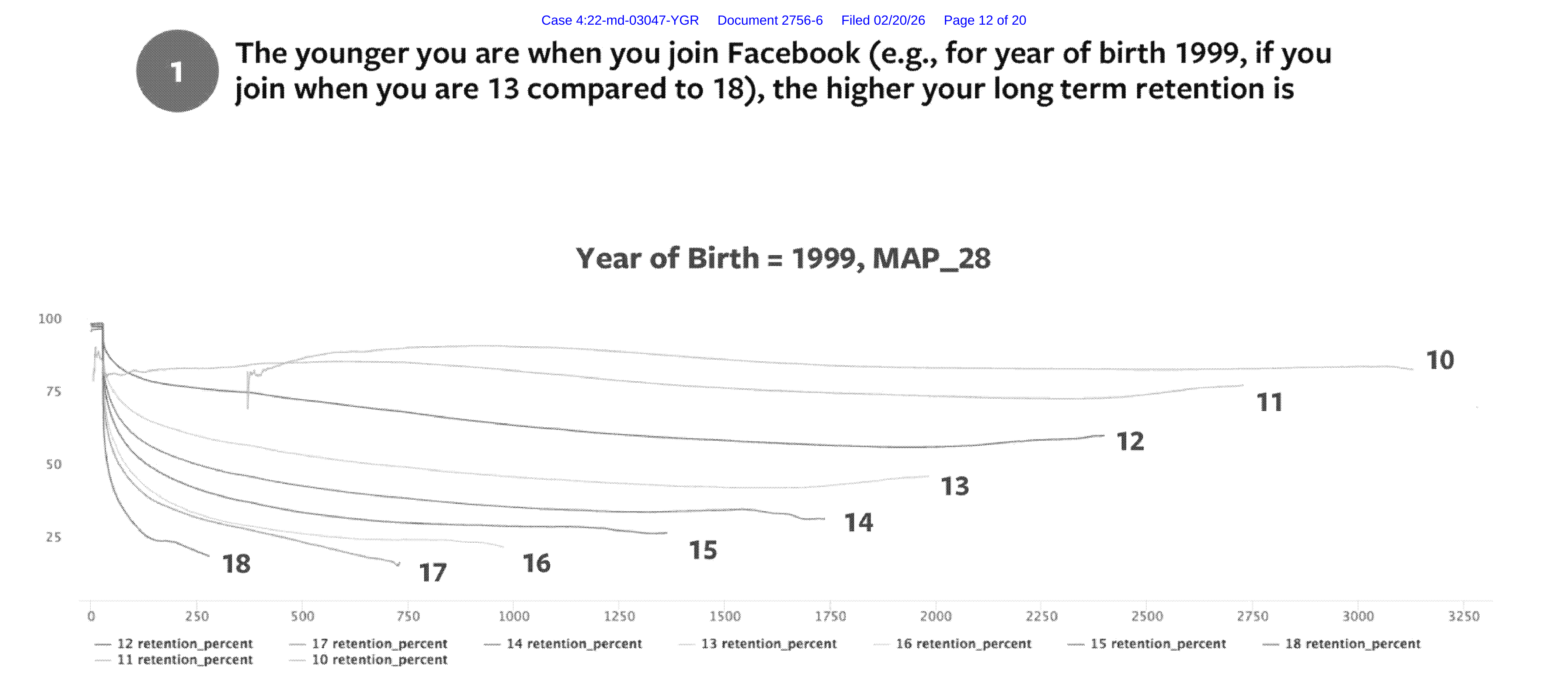
"Acquiring people when they are young (e.g., 13) results in the highest lifetime value because their long-term retention is the highest when they are young"
"'The young ones are the best ones'"
"The difference in long term retention can be dramatic, with the people who signed up for Facebook when they were young teens being 100% higher than those who joined FB as young adults"
2. "We care because it:"
• "Makes the case for why teens are important for Facebook and how important they are relative to other age groups"
"Findings thus far (PRELIMINARY)"
1. "The younger you are when you join Facebook (e.g., for year of birth 1999, if you join when you are 13 compared to 18), the higher your long term retention is"
2. "The more recently you were born (e.g., year 2001 instead of 1991), the higher your long term retention"
3. "The earlier you joined Facebook (e.g., 2009 instead of 2015), the higher your long term retention"
"Very Preliminary LTV Findings"
• "Acquiring people when they are young (e.g., 13) results in the highest lifetime value because their long-term retention is the highest when they are young"
• "Retention overpowers the fact that ARPU is lower for young people"
• "Retention overpowers the fact that future revenue is discounted"
• "However, we have a bit of a correlation issue"
• "People who join Facebook at a young age are different from people who don't join Facebook at a young age"
• "How might we adjust for this?"
 Meta & Children's Online Safety