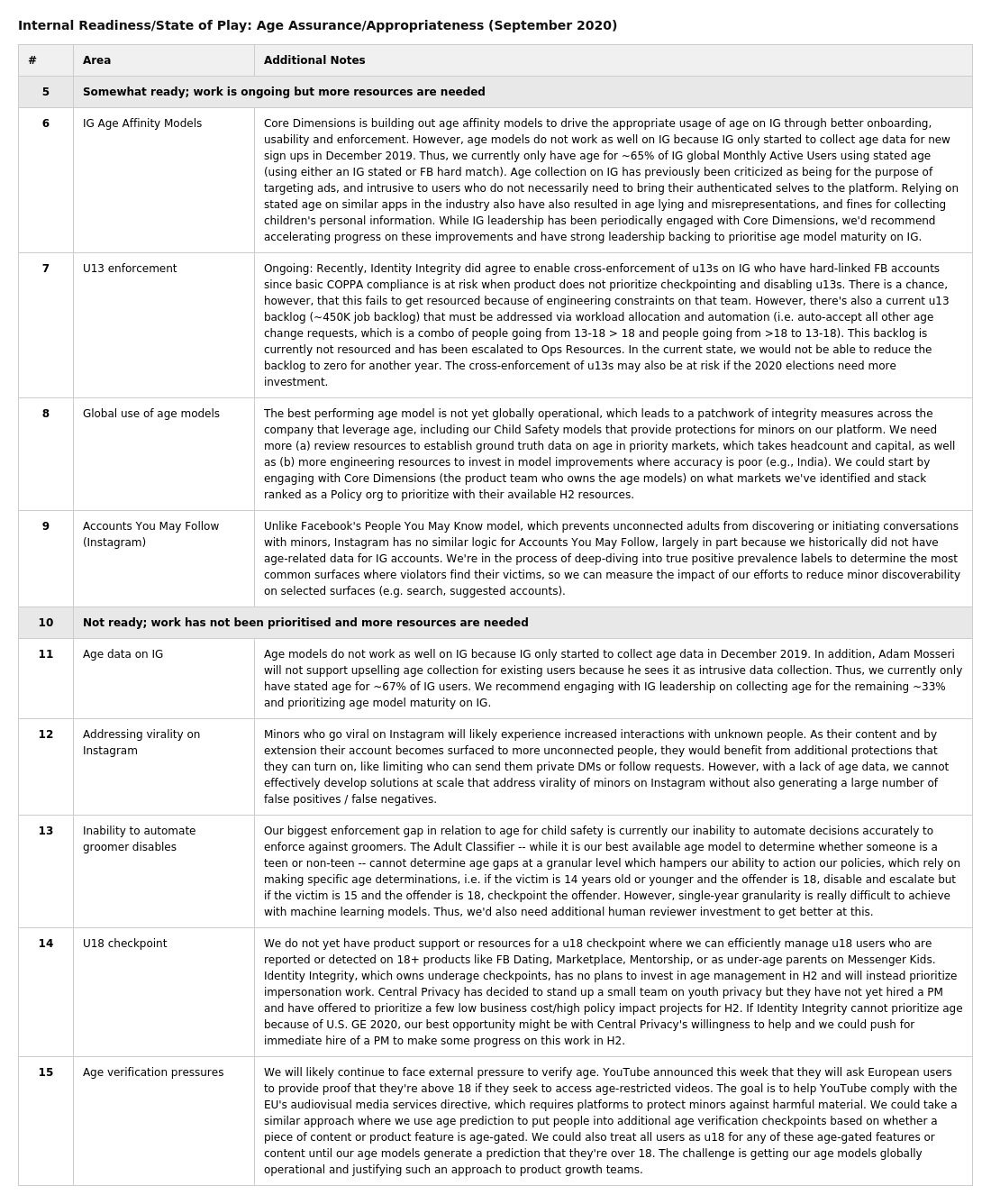
"Our biggest enforcement gap in relation to age for child safety is currently our inability to automate decisions accurately to enforce against groomers." - Internal Readiness/State of Play: Age Assurance/Appropriateness Table (Recreated)
Our biggest enforcement gap in relation to age for child safety is currently our inability to automate decisions accurately to enforce against groomers. The Adult Classifier — while it is our best available age model to determine whether someone is a teen or non-teen — cannot determine age gaps at a granular level, which hampers our ability to action our policies, which rely on making specific age determinations, i.e. if the victim is 14 years old or younger and the offender is 18, disable and escalate, but if the victim is 15 and the offender is 18, checkpoint the offender. However, single-year granularity is really difficult to achieve with machine learning models. Thus, we'd also need additional human reviewer investment to get better at this.
 Meta & Children's Online Safety