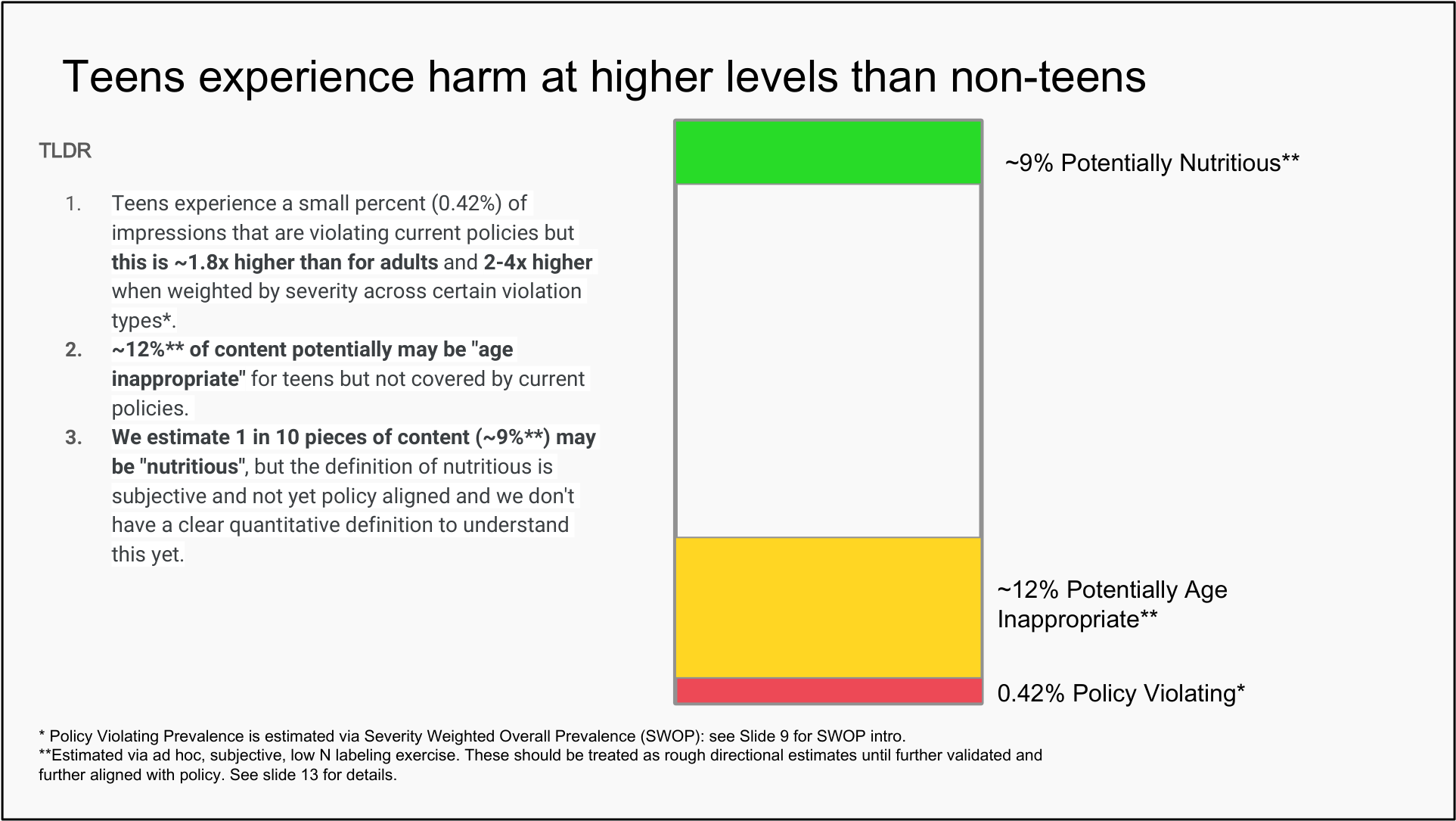
"Teens experience harm at higher levels than non-teens"
"1. Teens experience a small percent (0.42%) of impressions that are violating current policies but this is ~1.8x higher than for adults and 2-4x higher when weighted by severity across certain violation types.
2. ~12% of content potentially may be "age inappropriate" for teens but not covered by current policies.
3. We estimate 1 in 10 pieces of content (~9%) may be 'nutritious'"
"Teens see >2x prevalence for B&H, VNI, and SSI."
"The drivers of higher SWOPSWOPSeverity Weighted Overall PrevalenceSWOP = Prevalence * Severity. A severity-weighted metric for the prevalence of harmful content/experiences.Full entry ↗ are Bullying and Harassment (B&H), Suicide and Self Injury (SSI), and Violence and Incitement (V&I), which are all >2x higher prevalence for teens than the average user."
"Teens see ~9x SWOP in Hashtags compared to the average User; particularly across SSPx, Sexual Solicitation, and Nudity"
"Comments see high rates of Bullying and Harassment for Teens"
"Teens also see higher prevalence of harms on Home, particularly B+H, SSI, and VNI"
"While 0.42% of content is policy violating, we have reason to believe that ~12% of content is potentially inappropriate for early teens. And after viewing or engaging with inappropriate content, it starts to show up more and more on recommendation surfaces throughout the app."
"And of the ~88% of content that we believe may be appropriate for teens, only ~1 in 10 of them may be 'nutritious' for teens."
 Meta & Children's Online Safety